1985.
An Ariane rocket launched from the Space Centre at Kourou, French Guiana boosts into orbit the first of two Brazilian satellites to serve the telecommunications needs of that nation.
This is the story of Brasilsat.
I.
The roots of the project go back to 1968, when Hughes Communications International contracted RCA Canada to provide Ground Communications Equipment for Hughes’ Intelsat ‘A’ Earth Station in Tanguá, Brazil. This work was completed in 1969, and follow-on contracts were awarded to RCA throughout the 1970s to update the station as technology evolved.
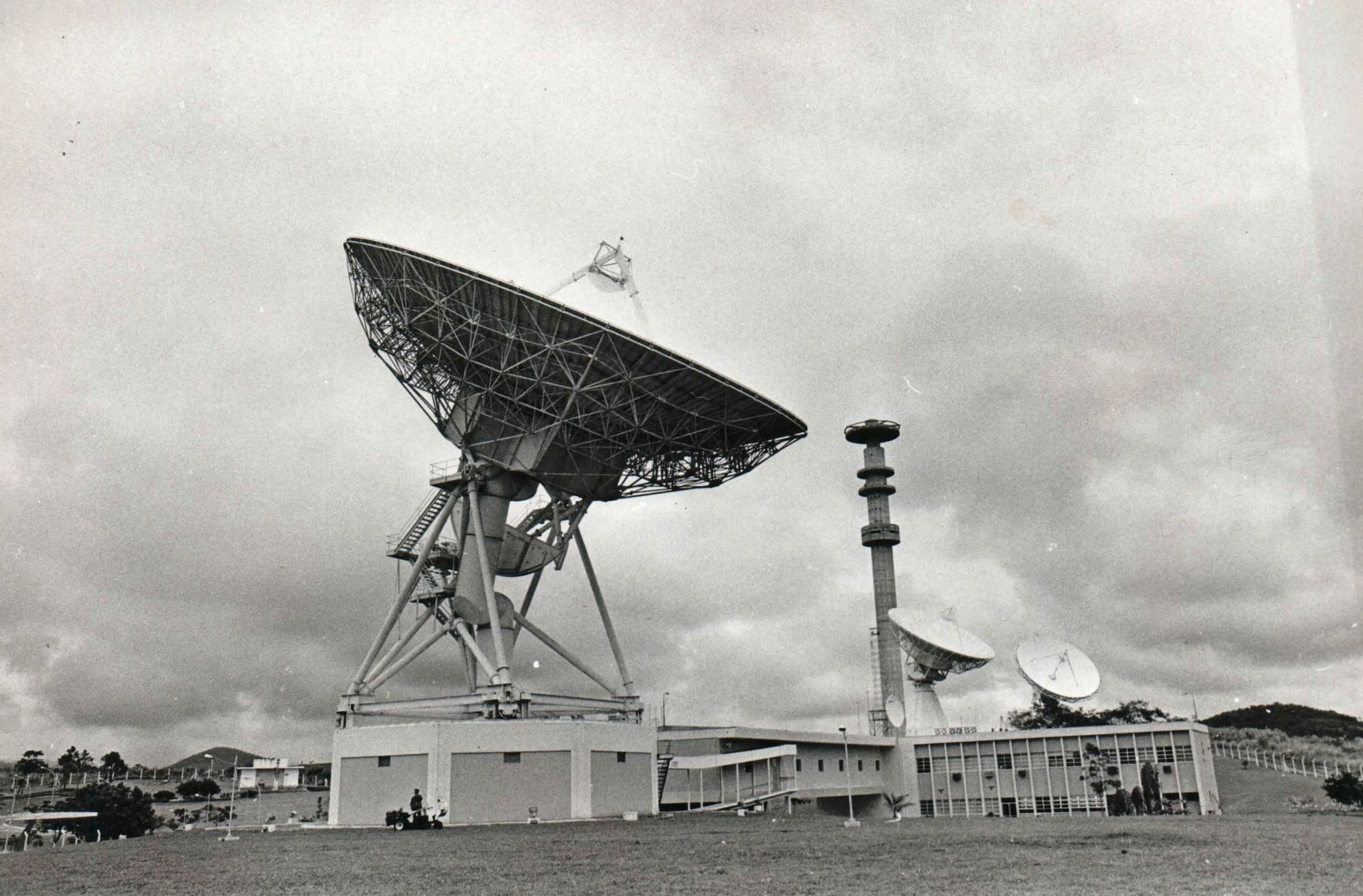
Intelsat Standard ‘A’ Earth Station in Tanguá, Brazil, 1976.
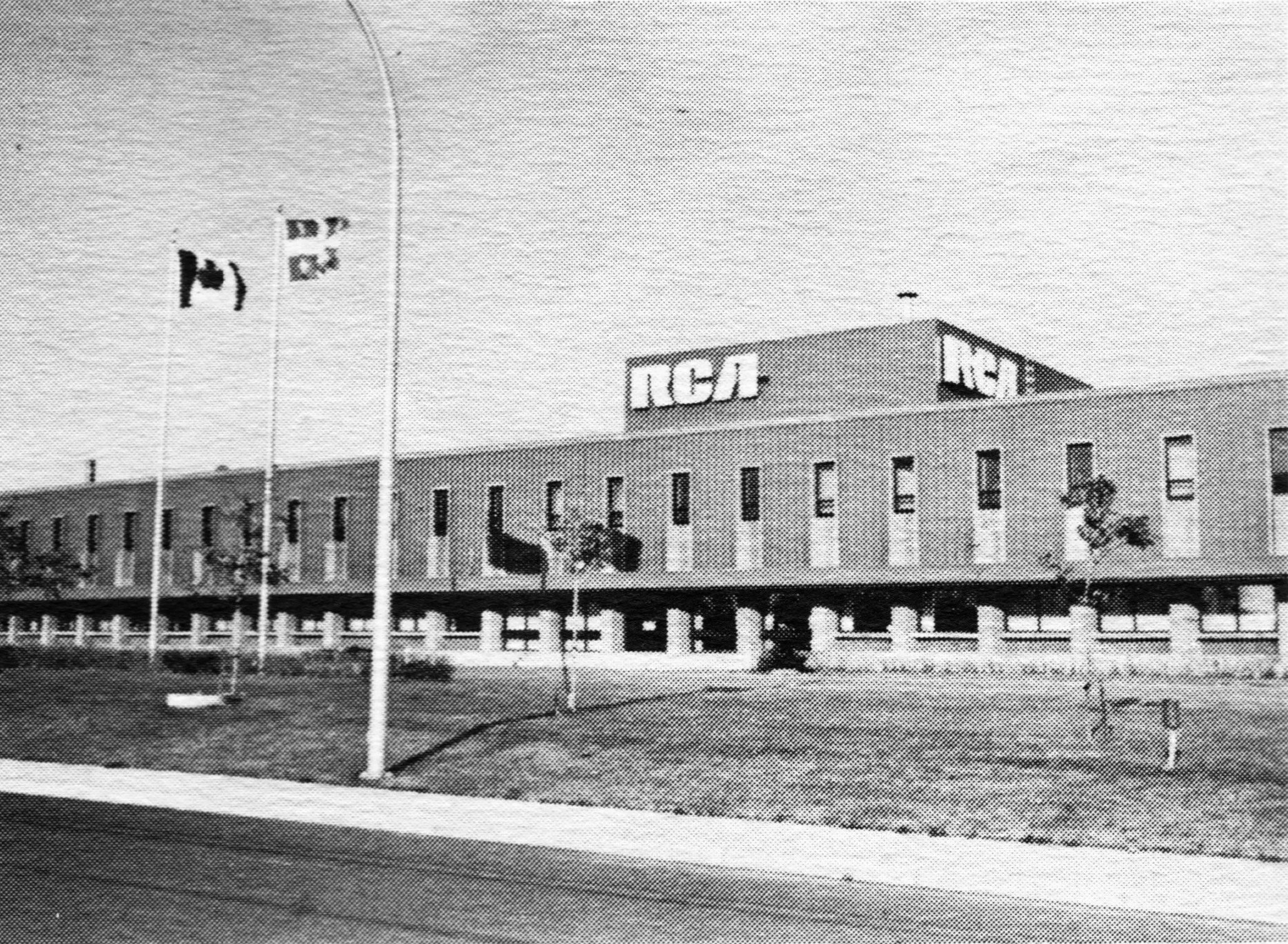
RCA Limited, Ste-Anne-de-Bellevue, Quebec, 1975.
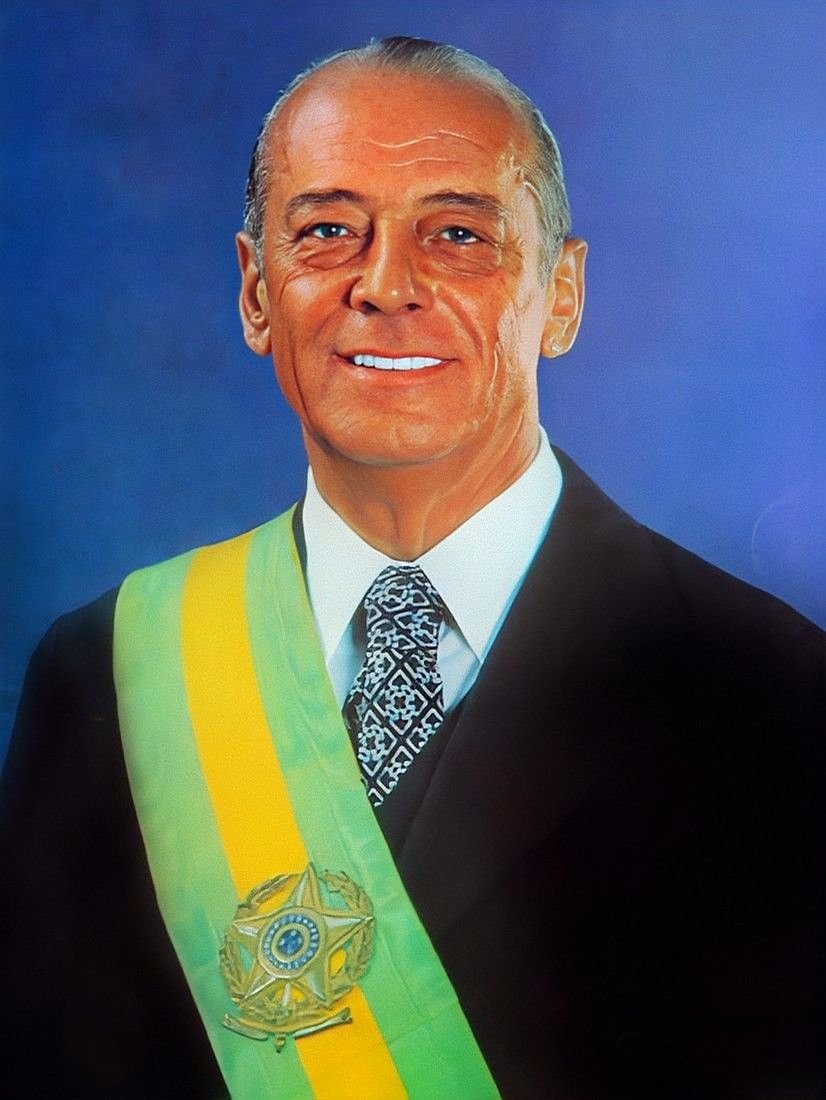
Portrait of João Figueiredo, 1979.
Brazil is a country of 8.8 million square kilometres, the largest country in South America. From 1968 to 1985, Brazil was under a military dictatorship, which reached the height of its popularity in the early 1970s despite human rights abuses, media censorship, and state-sponsored killings. Economic hardship in the mid-1970s led to mass protests. In 1979, João Figueiredo became president, and passed an amnesty law supporting Redemocratization. In 1982, free elections were introduced for the first time in 20 years.
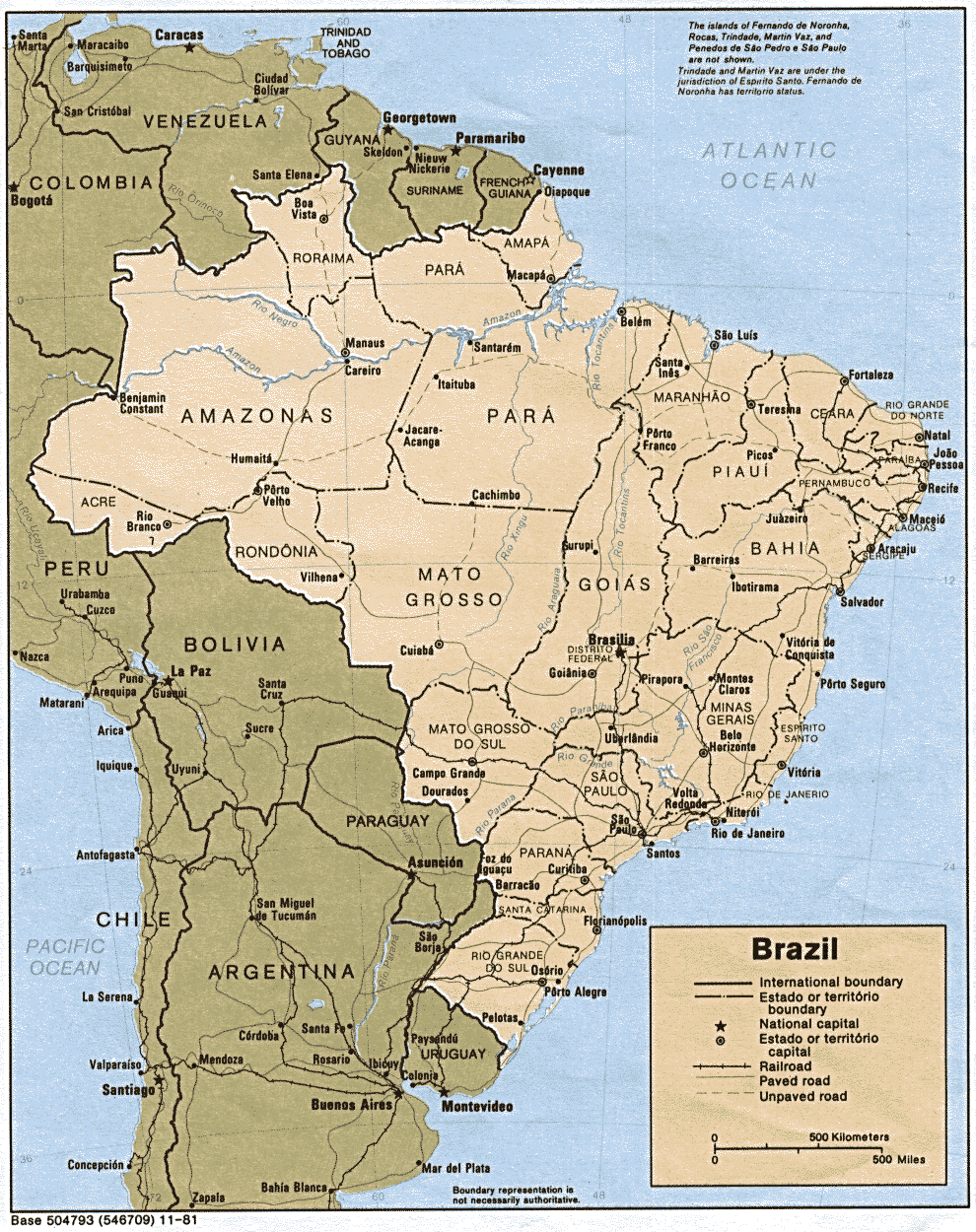
Political map of Brazil, 1981
In 1985, the election of a ruling opposition party marked the end of the dictatorship, and new constitution was ratified in 1988. Since, Brazil has been a stable democracy, maintaining status as a regional and middle power, and also as a rising global power.
II.
In 1977, concurrently to the goings-on in Brazil, Canadian aerospace company Spar Aerospace Limited acquired significant assets of RCA Canada Limited, mainly their Government and Commercial Systems Division and Research Laboratories based out of Sainte-Anne-de-Bellevue and Montréal, Quebec, respectively. This allows Spar to adopt and follow through with contracts previously won by RCA and procure new contracts. Ireal A. (Don) Mayson, who led the operation in Sainte-Anne-de-Bellevue as Vice-President and General Manager from 1970 until it was acquired by Spar, was instrumental in the smooth transition in management from one company to another. Spar Aerospace is best known as the designers and builders of the Shuttle Remote Manipulator System Canadarm for NASA.
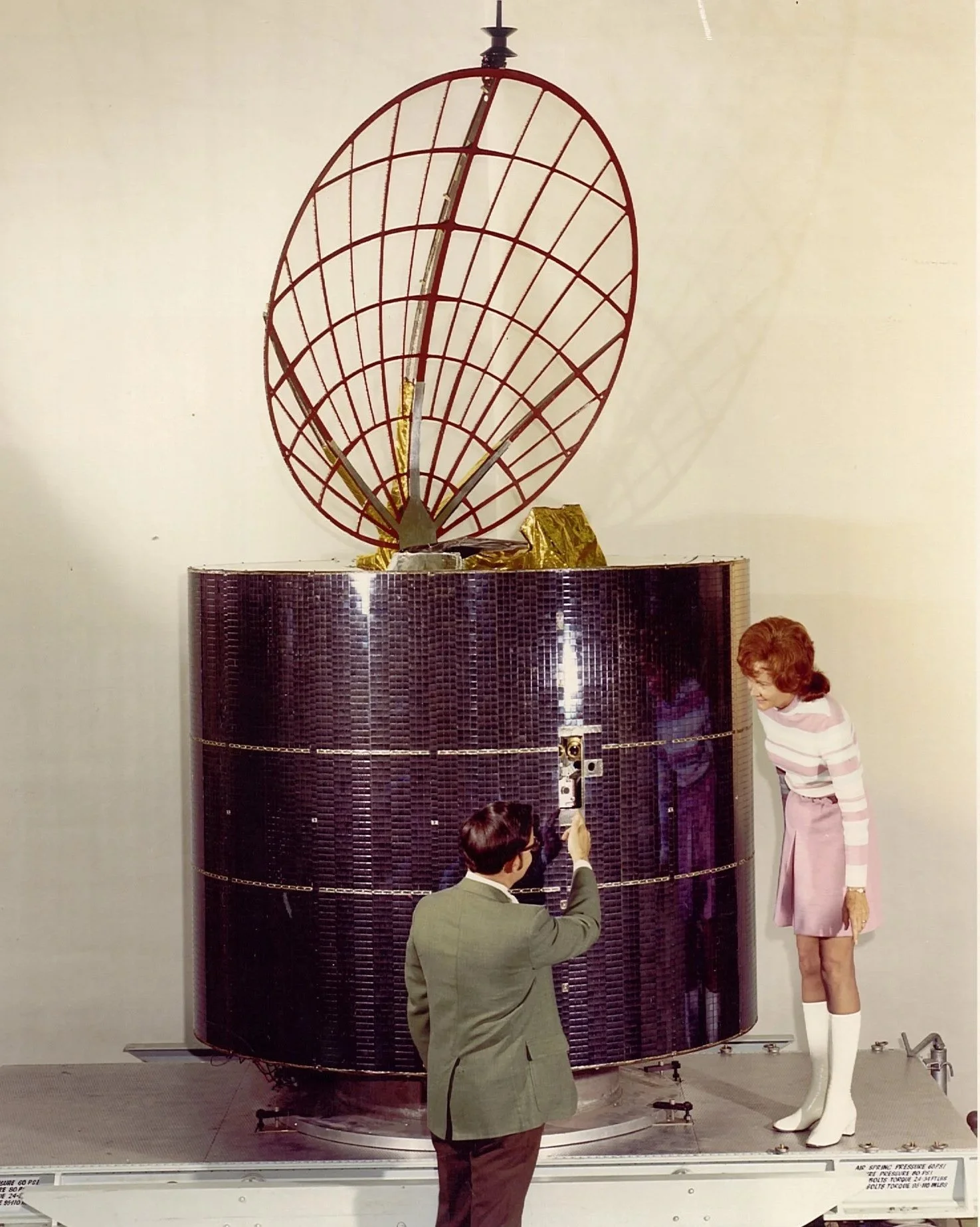
Anik A, the worlds first geostationary communication satellite, 1972.
“Canada was the third nation in the world to develop and orbit its own satellite. Alouette I was launched on September 29th, 1962, and Alouette II, ISIS I, and ISIS II followed. All of these were experimental satellites, and were joint projects with NASA.”
- Ireal A. (Don) Mayson
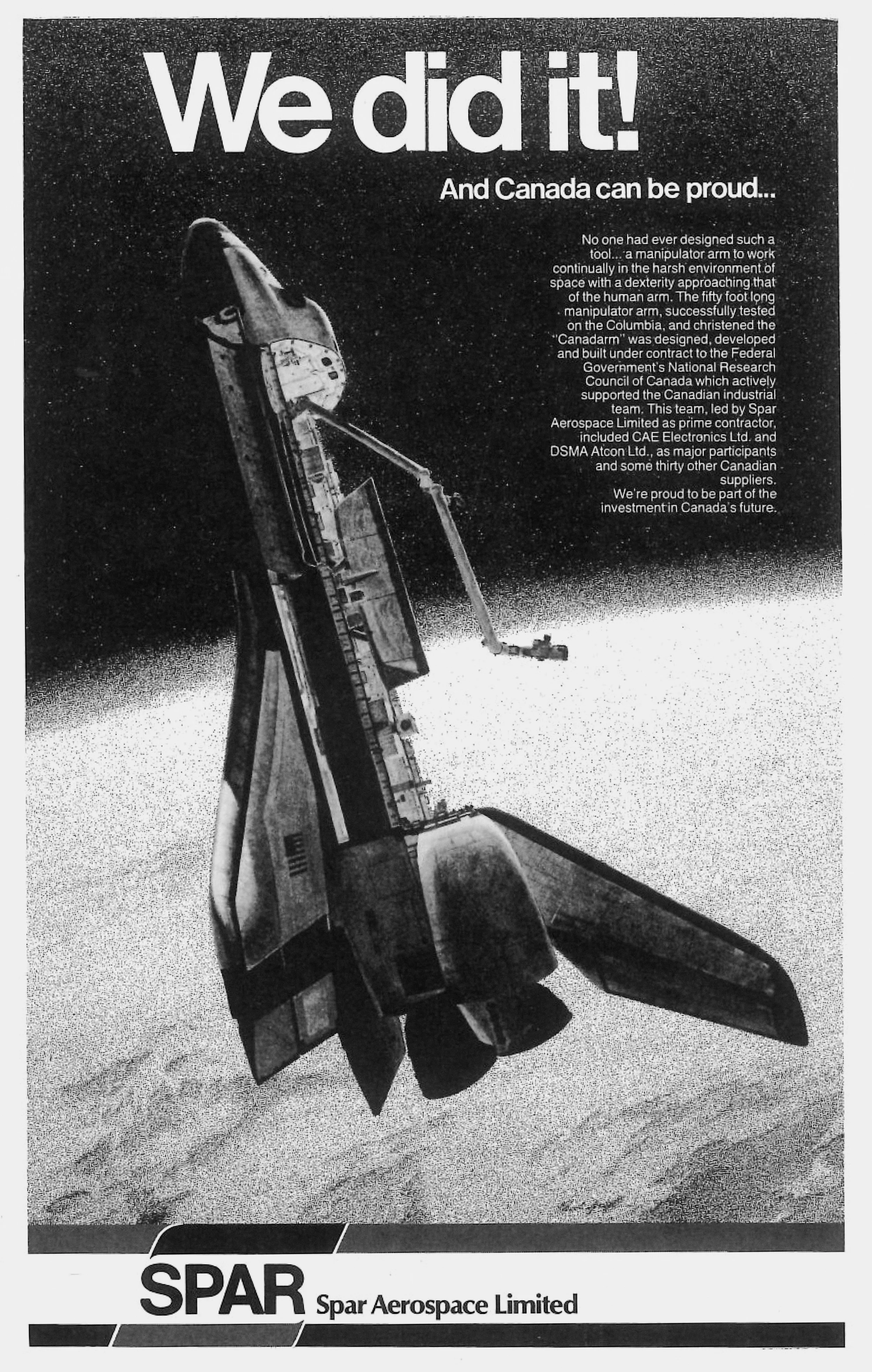
Spar Aerospace advertisement celebrating Canadarm, 1981.
RCA Limited was prime contractor on the Alouette II, ISIS I, and ISIS II satellites, and a sub-contractor on Anik A, Communications Technology Satellite Hermes, and Anik B. Spar Aerospace was a sub-contractor for Anik A, CTS Hermes, and Anik C, and in 1979 won the prime contract to build Anik D. All of the Anik satellites are communications satellites, and operated by Telesat Canada, a crown corporation from 1969-1998, and Canada’s main telecommunications company today. The need for a domestic communications satellite system in Canada stemmed from the fact that Canada is the second largest nation in the world in terms of size, and needed reliable, domestic control over communications to link Eastern, Western, and Northern communities. Brazil was facing a similar issue.

III.
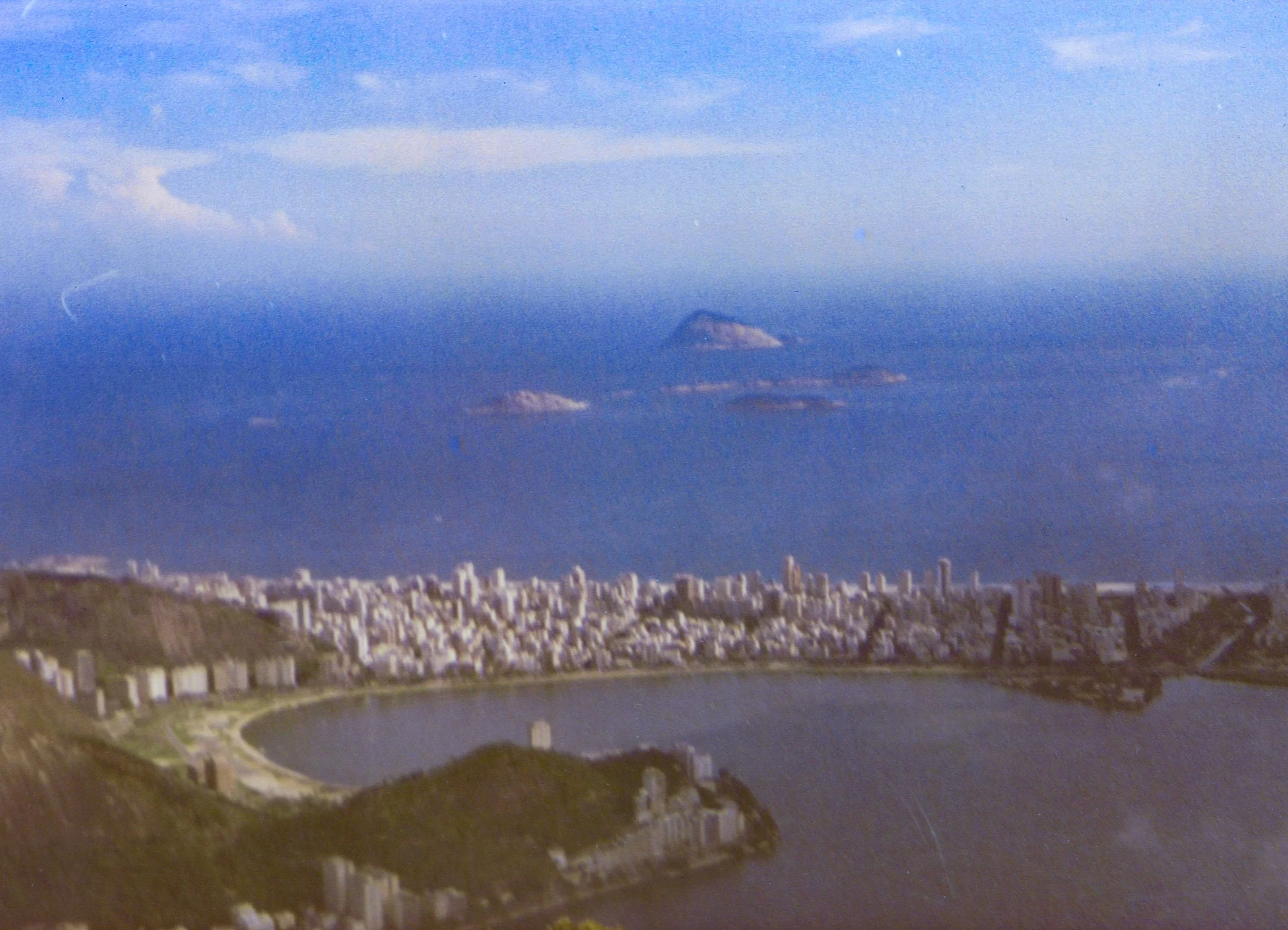
Photograph of Rio de Janeiro taken by Ireal
Since the installation of the Satellite Earth Station at Tanguá in 1969, Brazil had relied on Intelsat satellites to facilitate communication with the rest of the world, and within its borders. The Brazilian government had initially introduced a plan to implement its own domestic communications satellite system in 1975. This was for the same reasons Canada implemented its own system. Brazil sought to offer cost-effective service to its isolated population centres, such as the Amazon where no microwave links existed. Brazil also viewed the system in the future as supplying requirements for education, public health, and national security. International tenders were called and bids for the project were submitted in mid-1976, but due to the economic conditions which developed at the time, the government postponed these plans.

Embratel logo from 1965-1998
Embratel, founded in 1965 as Brazil’s state-owned communications company, would procure and manage operations of a domestic communications satellite system.
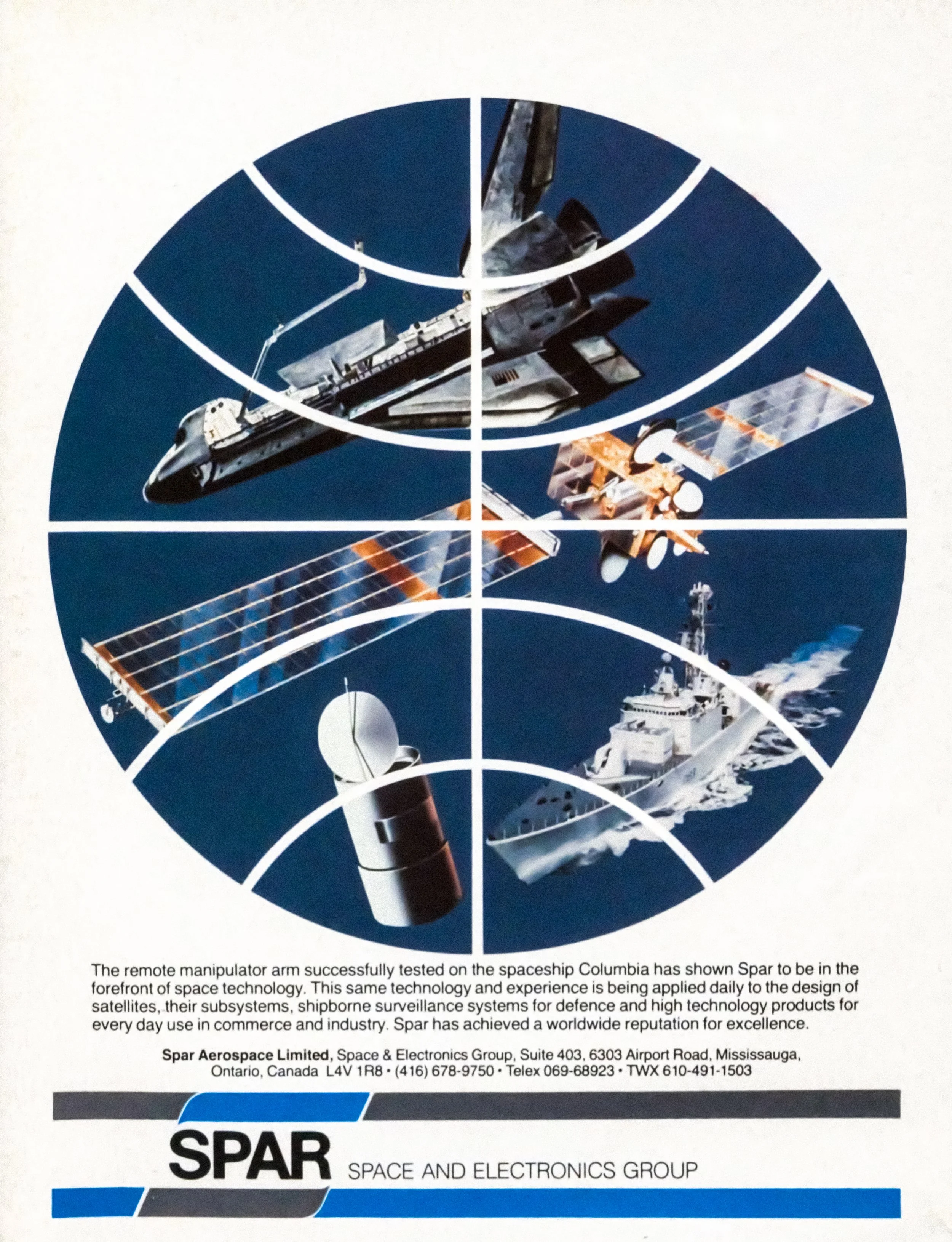
Spar Aerospace advertisement, 1982
In 1980, Brazil re-established plans for its satellite program. The Canadian Department of Communications (DOC) became aware of these plans, and visited Brazil in January, 1981. In early March, the DOC contacted Spar Aerospace to determine their interest in bidding Prime for the space segment of Brazil’s system. However, Spar was already undertaking a bid for the Mexican satellite system, and advised DOC that they could not undertake the Brazilian requirement as well. Brazil’s Ministry of Communications soon sent a fact-finding team to France, Canada, and the United States, visiting Spar’s Communications Systems Division. It became clear that the Brazilian requirements for a contract included offsets equal to the value of the contract, a low cost financing package, and technology transfer. A technical cooperation program was also discussed, in which the Brazilians showed considerable interest. Ireal, now Vice President of Business Development at Spar, visited Brazil in June to evaluate the situation.
IV.

Aerospatiale, 1980s.
The trip revealed that French aerospace companies, including Matra, and Aerospatiale, both of whom had been active in Brazil for some time, had considerable influence in the Brazilian government. The French had a long history of technology transfer and technical cooperation with Brazil. There were also close relationships with some Brazilian officials and senior French politicians. Ireal’s discussions with Embratel indicated the price of the satellite was very important, and that the contract would be for two satellites, one telemetry tracking and control station, a communications control centre, and in-orbit operation services for six months. The schedule was also critical, with service to be available by the end of the first quarter of 1985, the end of the presidents term of office.

Matra, 1990s.
Embratel settled on receiving bids from Matra, Aerospatiale, Hughes, RCA, Ford Aerospace, and Spar. On returning to Canada, meetings were held in with departments in Ottawa, and it was determined that federal support would follow in terms of competitive financing, training, offsets, and technical cooperation programs. Hughes and Spar signed an agreement at the end of July, 1981, stating that Hughes agreed to support Spar in a prime contract bid. Aerospatiale was established as a strong contender, particularly if Ford Aerospace bid with them. However, the French’s weaknesses included France’s lack of a domestic satellite system, and that neither Matra nor Aerospatiale had manufactured an operational communications satellite. Spar’s strengths included the history of cooperation between the Ministries of Communications in Brazil and Canada; Anik D, for which Spar is prime contractor, has specifications practically identical to Brazil; Support from Hughes, the worlds most experienced supplier of commercial satellite systems; and Spar/RCA’s past history as a supplier to Embratel. Weaknesses included that Spar was not yet a proven international supplier; no lobbying structure in place in Brazil; and Canadian trade imbalance with Brazil.

Hughes, 1980s.

Ford, 1980s.
V.
In August of 1981, Spar was invited to give a presentation on its history, past experience, and future developments in the communications field. Shortly after, they were invited to present their proposals for a domestic satellite system for Brazil. Matra and Aerospatiale also made presentations, while RCA declined to bid. Spar’s presentation was very well received, having emphasized Telesat Canada’s experience in managing a domestic communications satellite system, the similarities between Canada and Brazil in the communications field, and Spar and Hughes’ extensive satellite experience.

Victori Eletrônica, 1980s.
Ireal and Spar’s team met with Victori Eletrônica Limited, a Brazilian company with considerable experience in representing foreign electronics companies in Brazil, who were also associated with Brazil’s largest newspaper chain and TV network, the O Globo organization. Meetings were held with the presidents of Victori and O Globo, and in early September, Spar appointed Victori as their agent. Senior Canadian government officials soon visited Brasilia to meet their counterparts and to support Spar’s bid. In October, Hughes advised the Ministry of Communications in Brasilia that they would not be submitting a prime bid, but would vigorously support the Spar proposal. Spar’s proposal included SED Systems, located in Saskatoon, Saskatchewan, and would be responsible for the ground segment of the system. Only Spar and Aerospatiale submitted proposals for the pre-selection process, Spar supported by Hughes and SED, and Aerospatiale supported by Ford and Thomson-CSF.

SED Systems, 1985
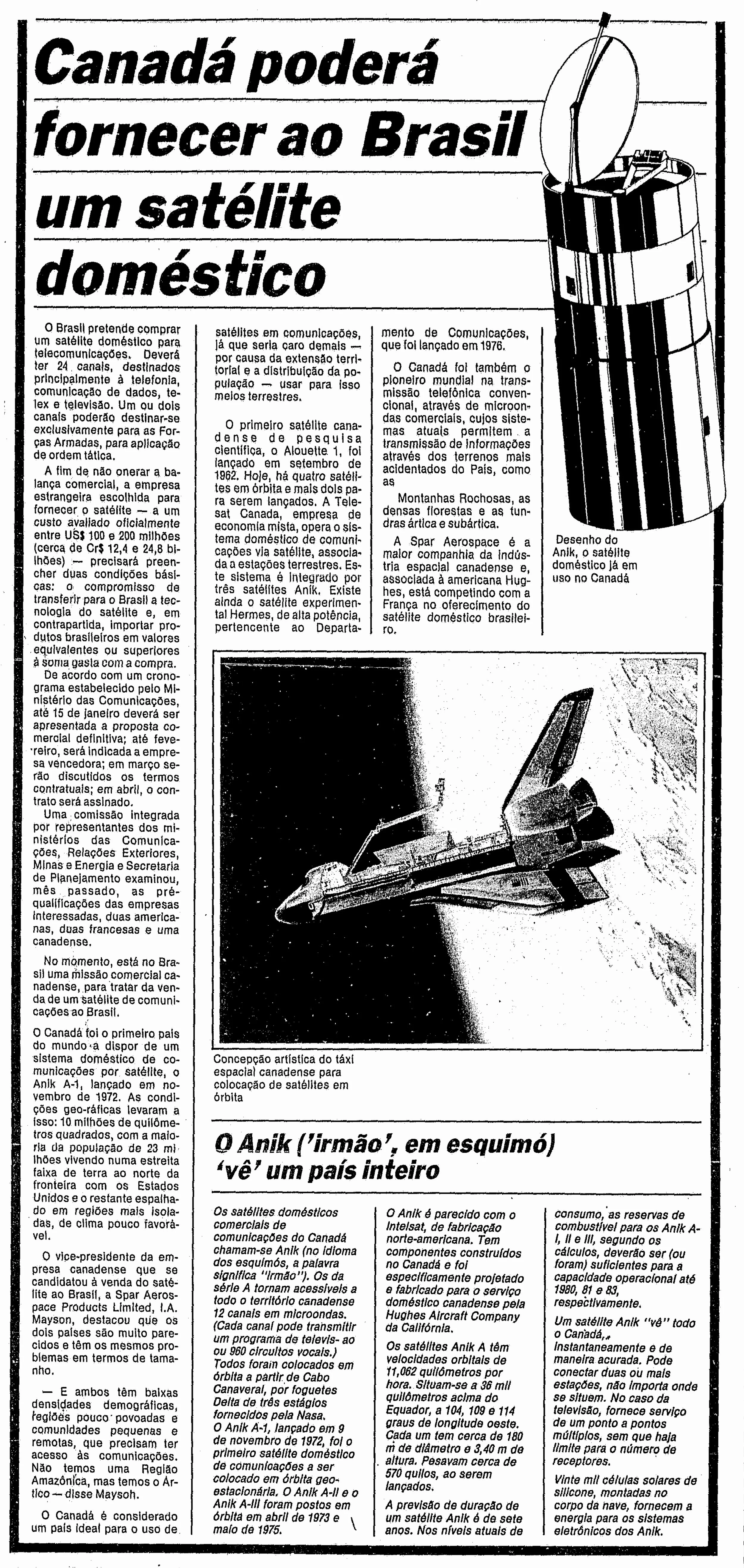
“Canada may supply Brazil with a domestic satellite,” O Globo, December 14th, 1981.
“Both have low population densities, sparsely populated regions, and small, remote communities that need access to communications. We don’t have an Amazon region, but we do have the Arctic,” said Mayson.
VI.
Spar’s final proposal was submitted on January 15th, 1982. Embratel was disappointed in the prices of both Spar and Aerospatiale’s proposals, while indications pointed towards Spar having the lower bid, even though Aerospatiale’s financing package was lower than Spar’s. Several separate meetings took place in the month of February to discuss potential areas of cost reduction. Spar and Aerospatiale each met with Rômulo Villar Furtado, Secretary General of the Ministry of Communications, in Brasilia, who indicated that the price must be reduced on the basis of current bids.
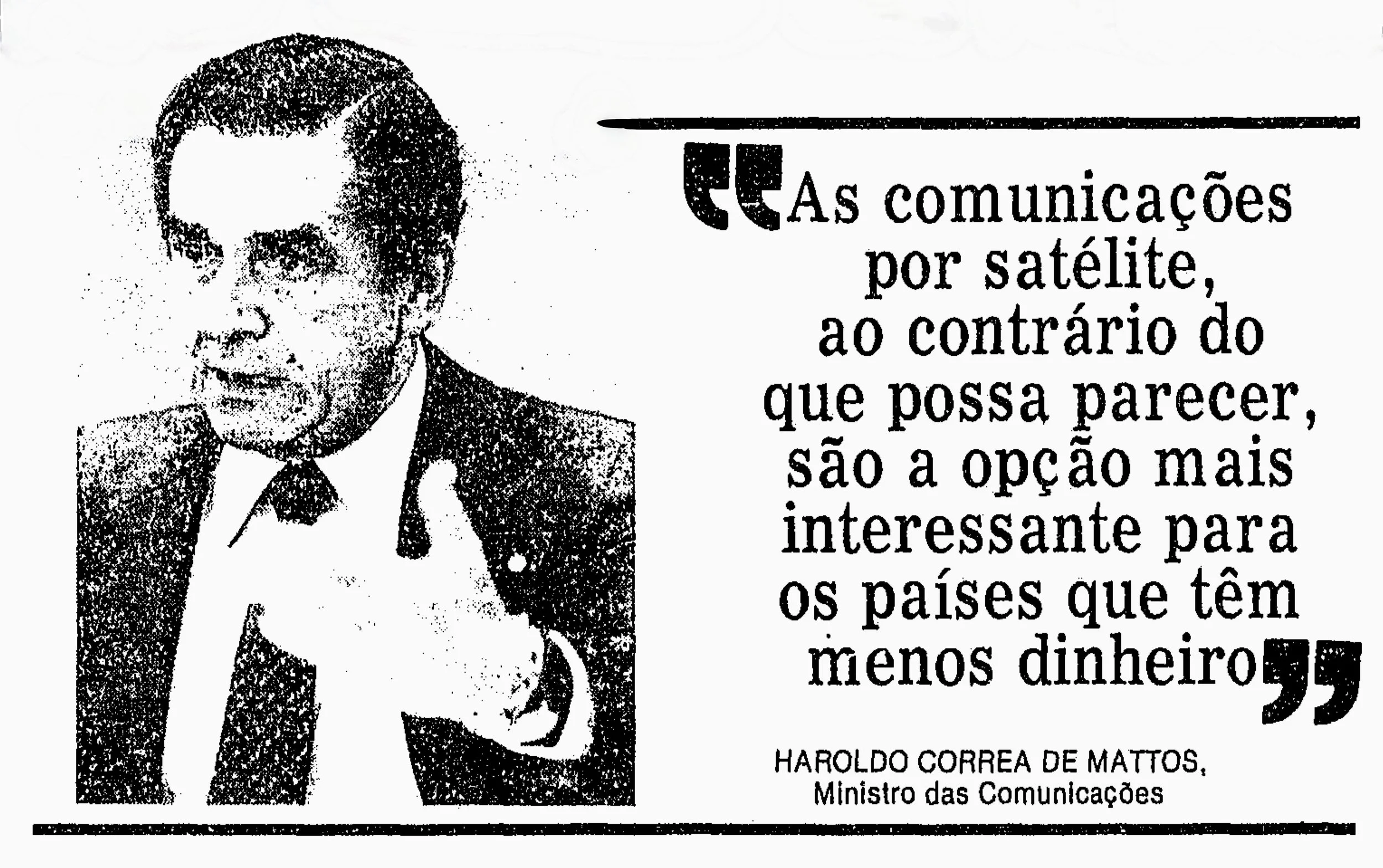
“Satellite communications, contrary to what one might expect, are the most attractive option for countries with fewer financial resources.” - Haroldo Corrêa de Mattos, Minister of Communications, 1979-1985
“In spite of the pressure-cooker situation that resulted, all proceedings ground to a complete halt during the five days of Carnaval to the total frustration of Spar Toronto.”
- Ireal A. (Don) Mayson

Carnaval in Rio, LeRoy Neiman, 1982.
On March 29th, Spar submitted their final price proposal which contained a substantial reduction as a result of the elimination of some items, differences in exchange rates, and more. However, after Spar’s proposal submission, Aerospatiale mounted a tremendous campaign in the press to discredit Spar, and attempted to convince Embratel that Aerospatiale was in fact offering a very low-risk satellite. On April 4th, in the Jornal do Brasil, an article appeared which mentioned the Canadian consortium SPAR “which knows nothing about satellites.” Spar’s association with the O Globo newspaper chain enabled them to publish an article in their paper, and an advertisement in the Jornal which disputed this claim.
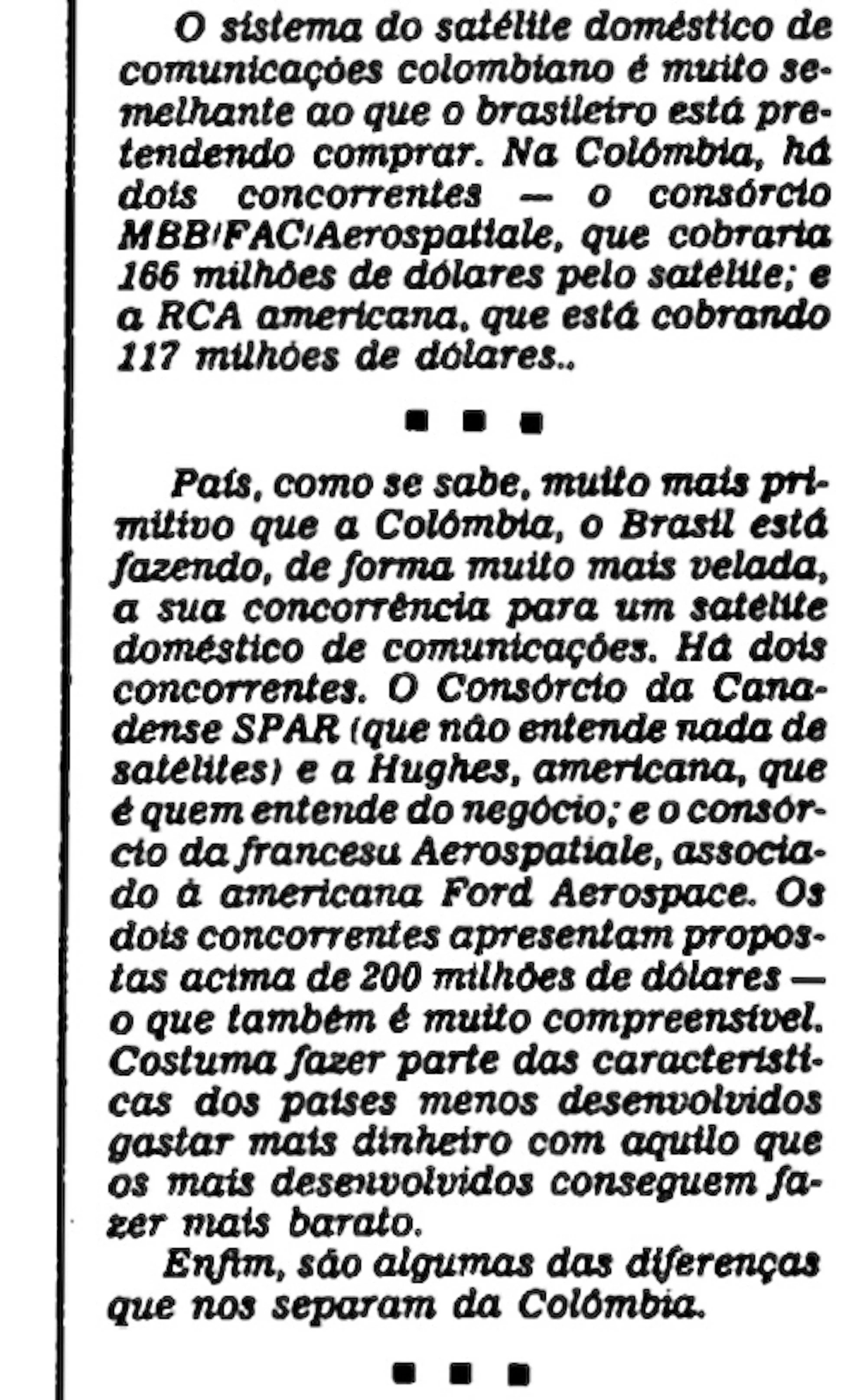
“…There are two competitors. The Canadian consortium SPAR (which knows nothing about satellites) and Hughes, an American company that does understand the business…” Jornal do Brasil, April 4th, 1982.
VII.

Insat 1A officially abandoned, September 7th, 1982
Aerospatiale were offering a satellite which had significant risk in that it had never been produced before and introduced a new power tube which in nearly all satellites represents a critical component. Fortune favoured Spar at this point. The Indian satellite Insat 1A, for which Ford Aerospace was prime contractor had run into serious delay problems in their launch. Additionally, after launch one of the “C” band antenna reflectors failed to deploy. Ireal and the Spar team created a New Delhi reporter who published articles in the O Globo newspaper to highlight these problems and the risks involved. In mid-April, Aerospatiale hosted its President, Jacques Mitterrand, who incidentally was the brother of then-President of France, François Mitterrand, and other French diplomats in Brasilia. During this period, Spar concentrated on the fact that Anik D, practically identical to Brasilsat was to be launched in August of 1982, making this procurement essentially off-the-shelf technology. Spar’s feedback indicated that they were lower in price, had a satisfactory offset proposal, and an excellent technical cooperation program, but that their complementary financing program was not as attractive as Aerospatiale’s. However, on May 5th, Ireal himself found out the news Spar had been waiting for.
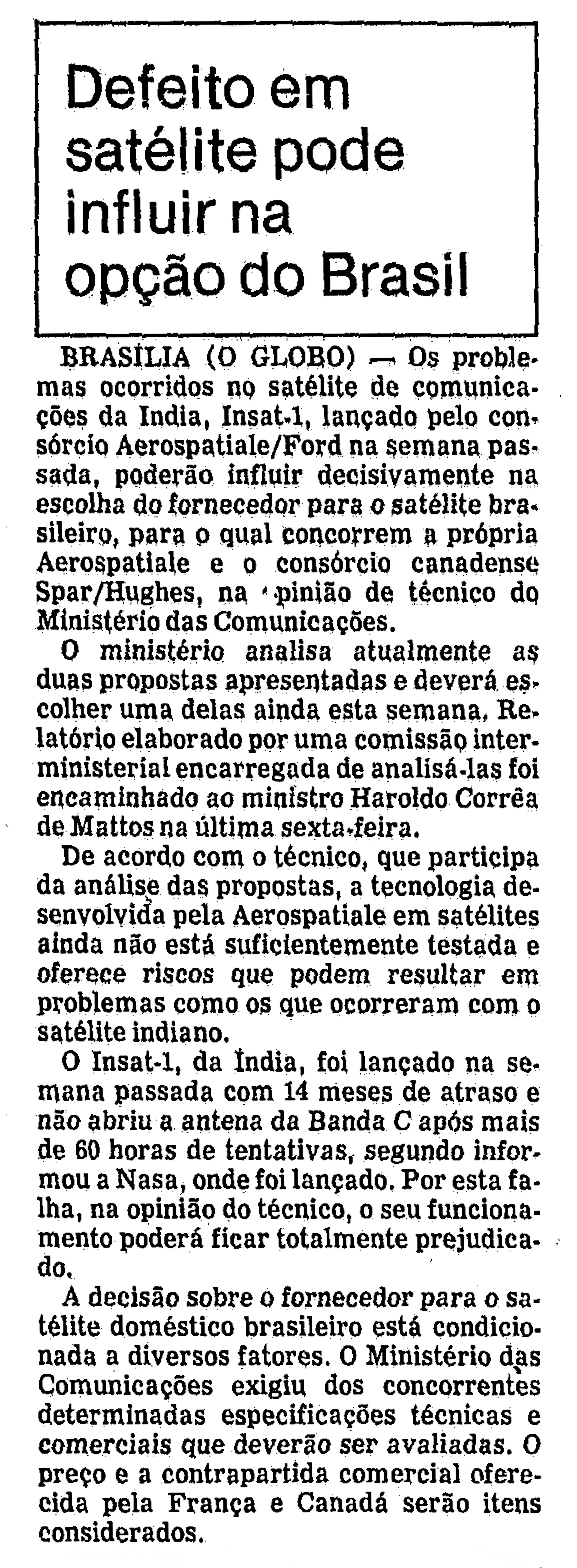
“Defect in satellite may influence Brazil’s decision” O Globo, April 20th, 1982
“On May 5, 1982, I was invited to Brasilia to a meeting with the Secretary General of the Ministry of Communications who congratulated me and handed me a letter stating that we had been selected for negotiation. I told him I was very excited about the news and he told me I was not nearly as excited as the French when they were told. He further told me that the French Ambassador was waiting in the ante-room to see him. I left via a different door.”
- Ireal A. (Don) Mayson
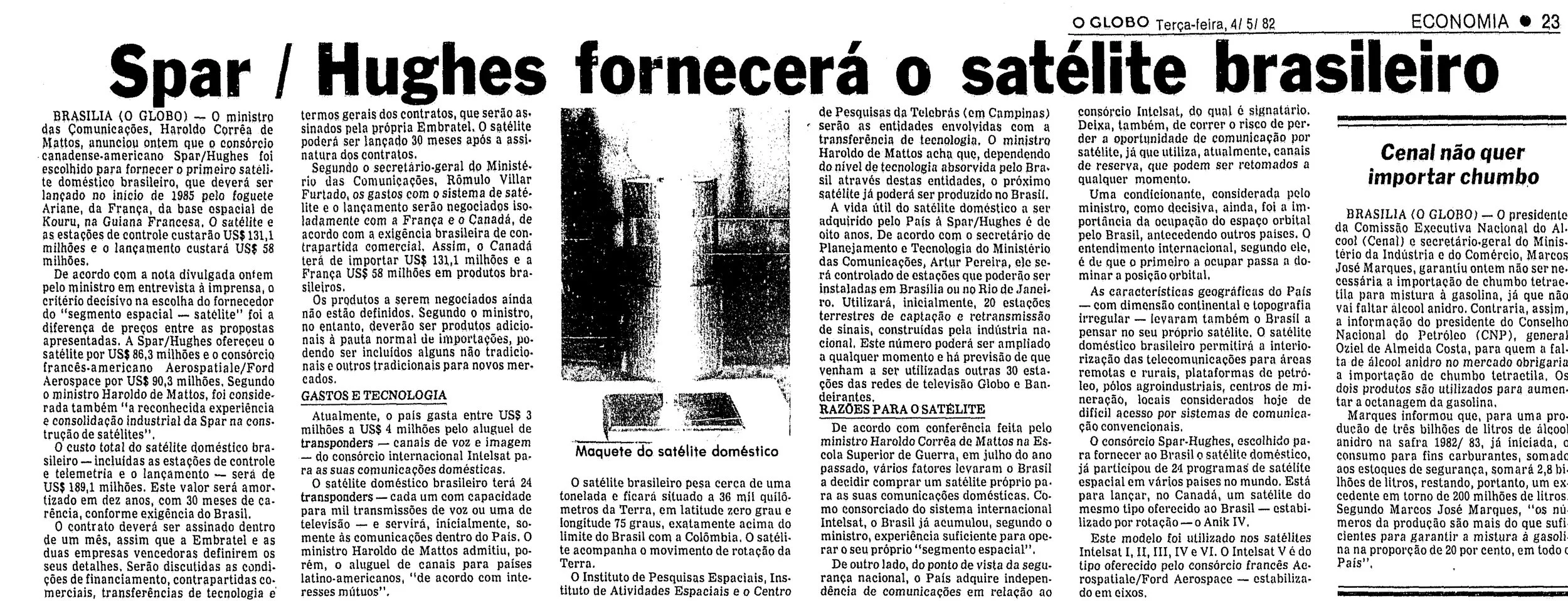
Spar/Hughes will supply the Brazilian satellite, May 5th, 1982
VIII.
There was still the entire range of contract negotiations before a contract could be signed. The negotiations were difficult, ranging over delivery penalties, prices, incentives, terms and conditions, and technical specifications. Aerospatiale mounted a team in Rio and Brasilia for the entire period up until the contract was signed on June 30th, 1982. On July 20th, Brazilian President, João Figueiredo made a state visit to Ottawa, cementing trade deals between Brazil and Canada, including finalizing the deal for Brazil’s domestic communications satellite system with Spar.
The total value of the contract was $165 million dollars, and included; an offset program in which Spar agreed to work with Brazil to develop their export business either to Canada or other countries; the Spar-led training of Brazilian engineers in the use of space technology; and the sale of additional goods and services to Brazil involving either Spar or non-Spar produced items.
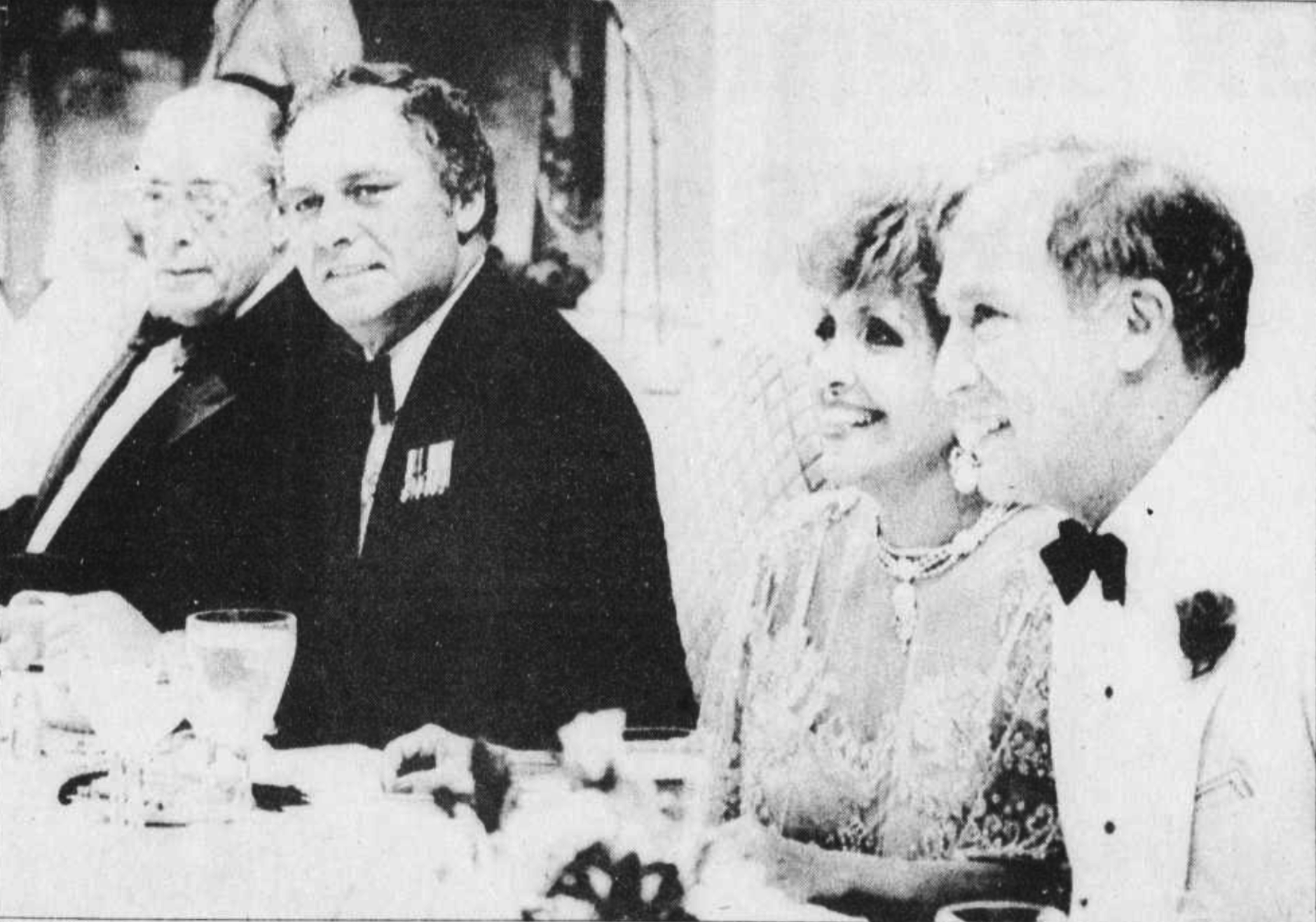
(Left to Right) João Figueiredo, former Governor General Edward Schreyer, Dulce Figueiredo, and former Prime Minister Pierre Elliott Trudeau, July 20th, 1982.
“Both parties maintained their cool reasonably well and there was considerable give and take on both sides. It was one of those rare negotiations where both parties felt that they had concluded a good deal.”
- Ireal A. (Don) Mayson
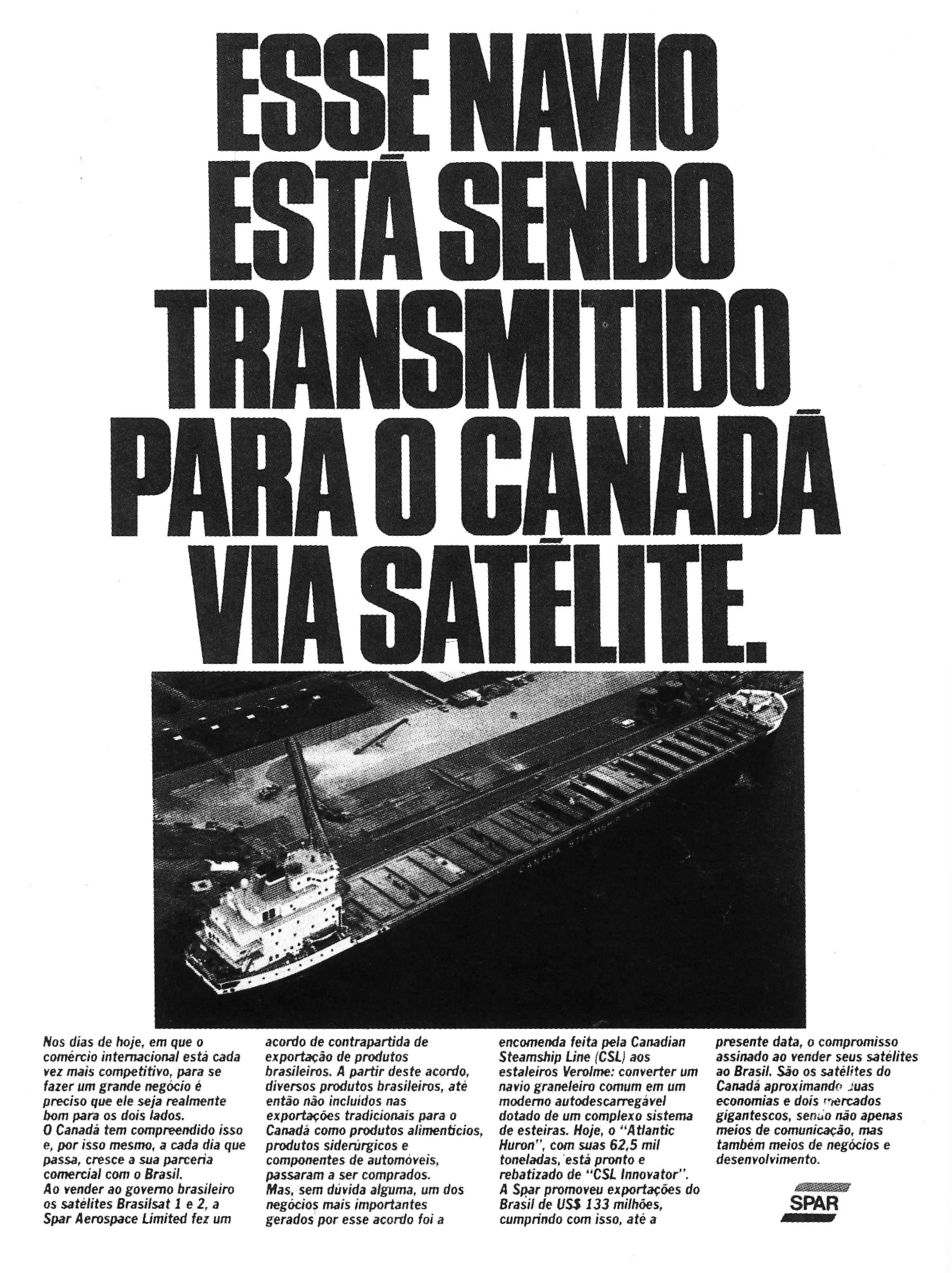
“This Ship is Being Transported to Canada Via Satellite.”
The contract established Spar as a prime contractor for international satellite systems, and resulted in closer relations with Brazil in terms of both industry and government for decades to come. Despite this however, Brasilsat would end up being Spar’s only international satellite prime contract in its 30-year history.
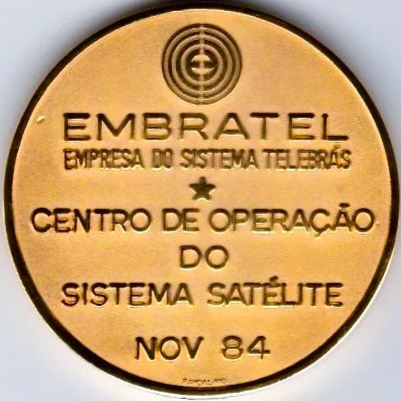
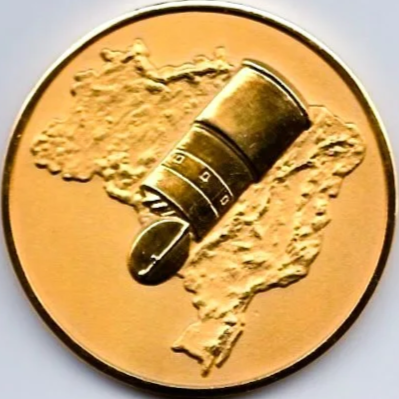
Embratel medallion commemorating the opening of the Control Centre for Brasilsat, 1984.
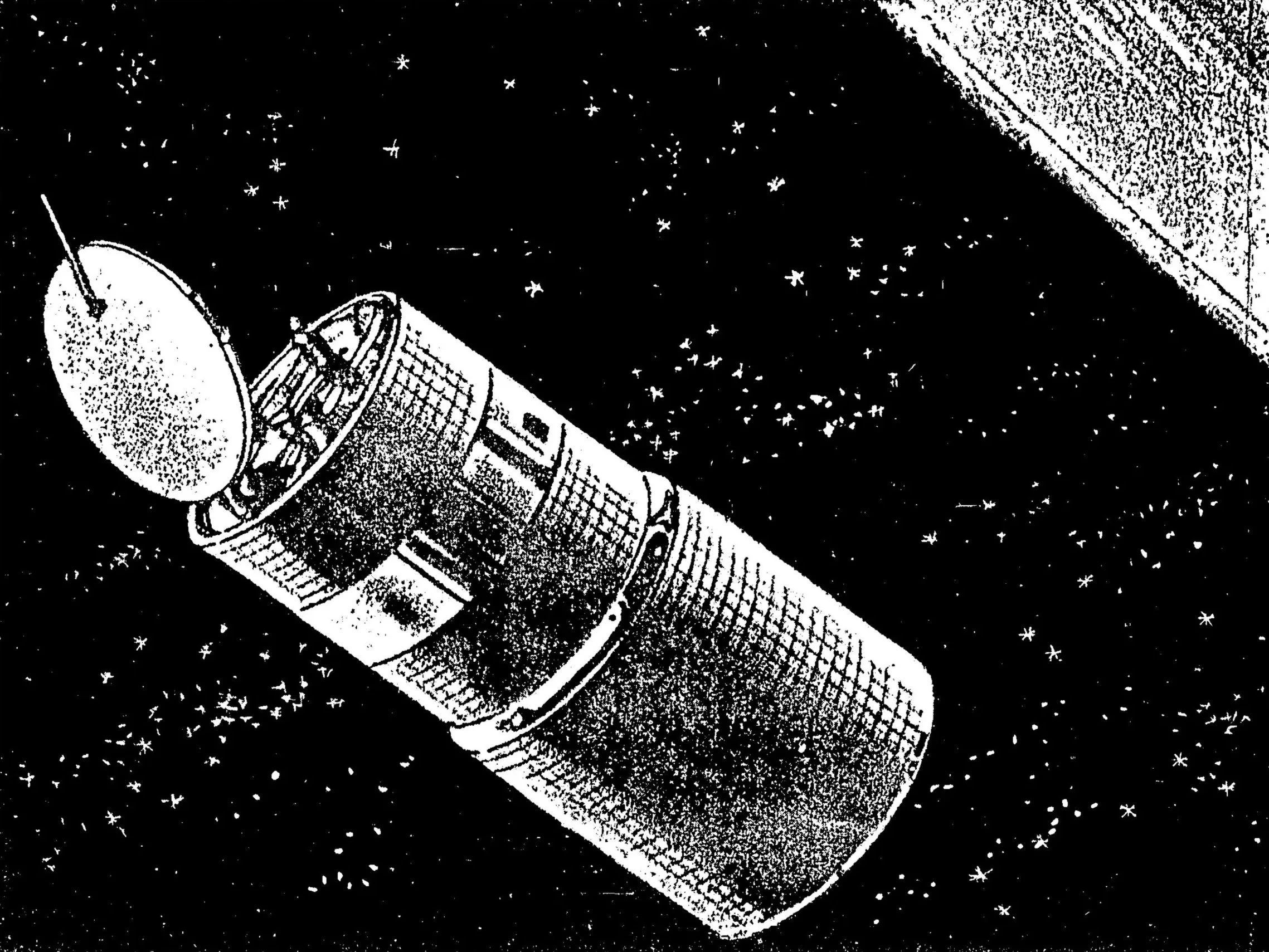
Rendering of Brasilsat in orbit, O Globo, February 8th, 1982.
IX.
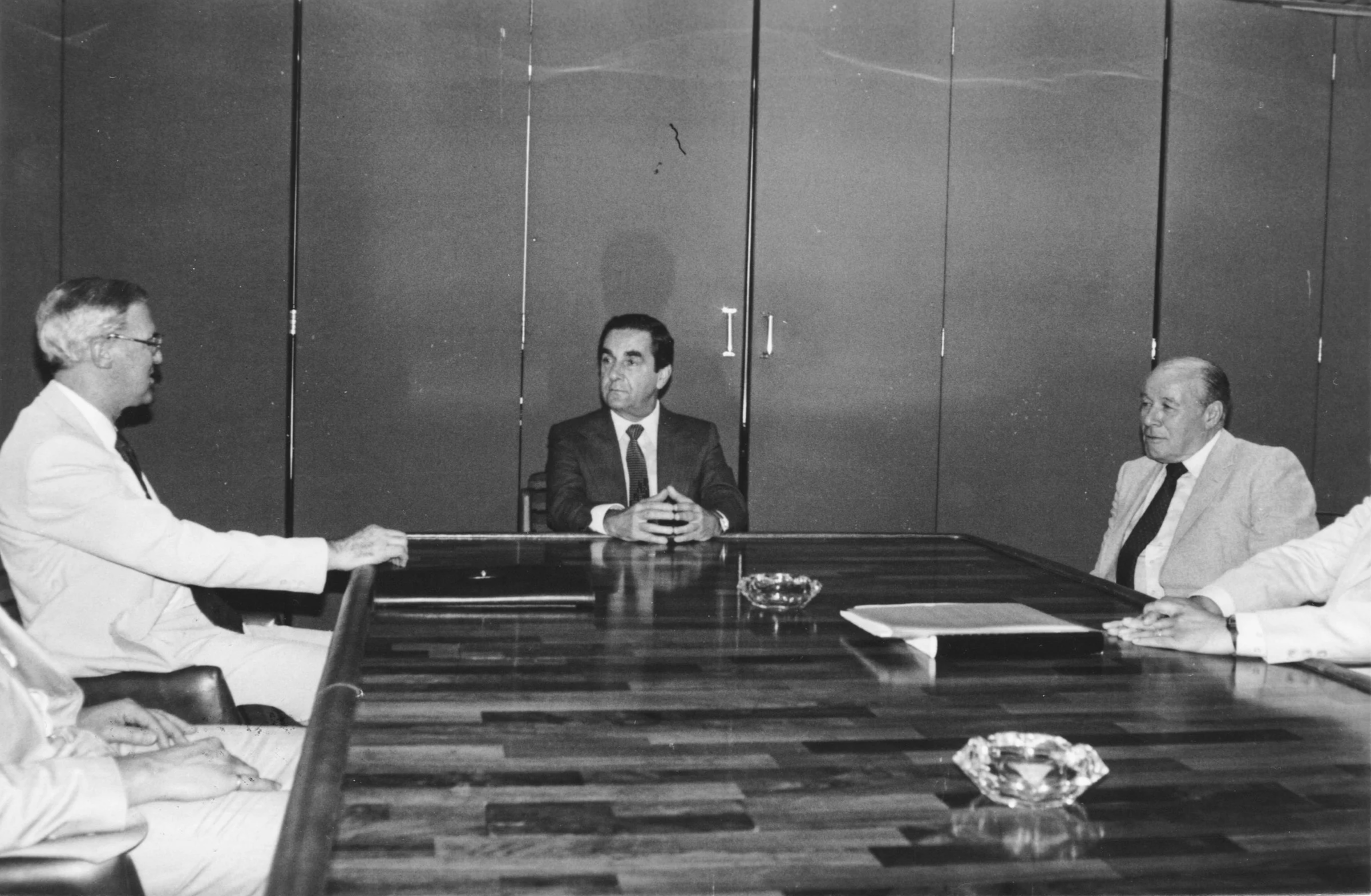
Spar CEO Larry D. Clarke (left) with Minister of Communications Haroldo de Mattos (centre) with Ireal A. (Don) Mayson, 1982.
The first of the two satellites, Brasilsat I was launched on February 8th, 1985 from the Space Centre at Kourou, French Guiana, and Brasilsat II was launched a little over a year later, on March 28th, 1986. The entire system, known as SBTS (Sistema Brasileiro de Telecomunicações por Satélite) linked together far flung reaches of Brazil, from Cruzeiro do Sul in the west to Natal in the east; from Boa Vista in the north to Pelotas in the south. For the first time ever, Brazilians were able make telephone calls as easily from Brasilia to Sao Gabriel as they could across town in Rio de Janeiro. Television programs could be seen simultaneously in São Paulo, Cuiaba, Porto Velho and many more distant centres in Brazil. Data transmissions, educational radio and TV programs were all made instantly available by the two 24-channel satellites.
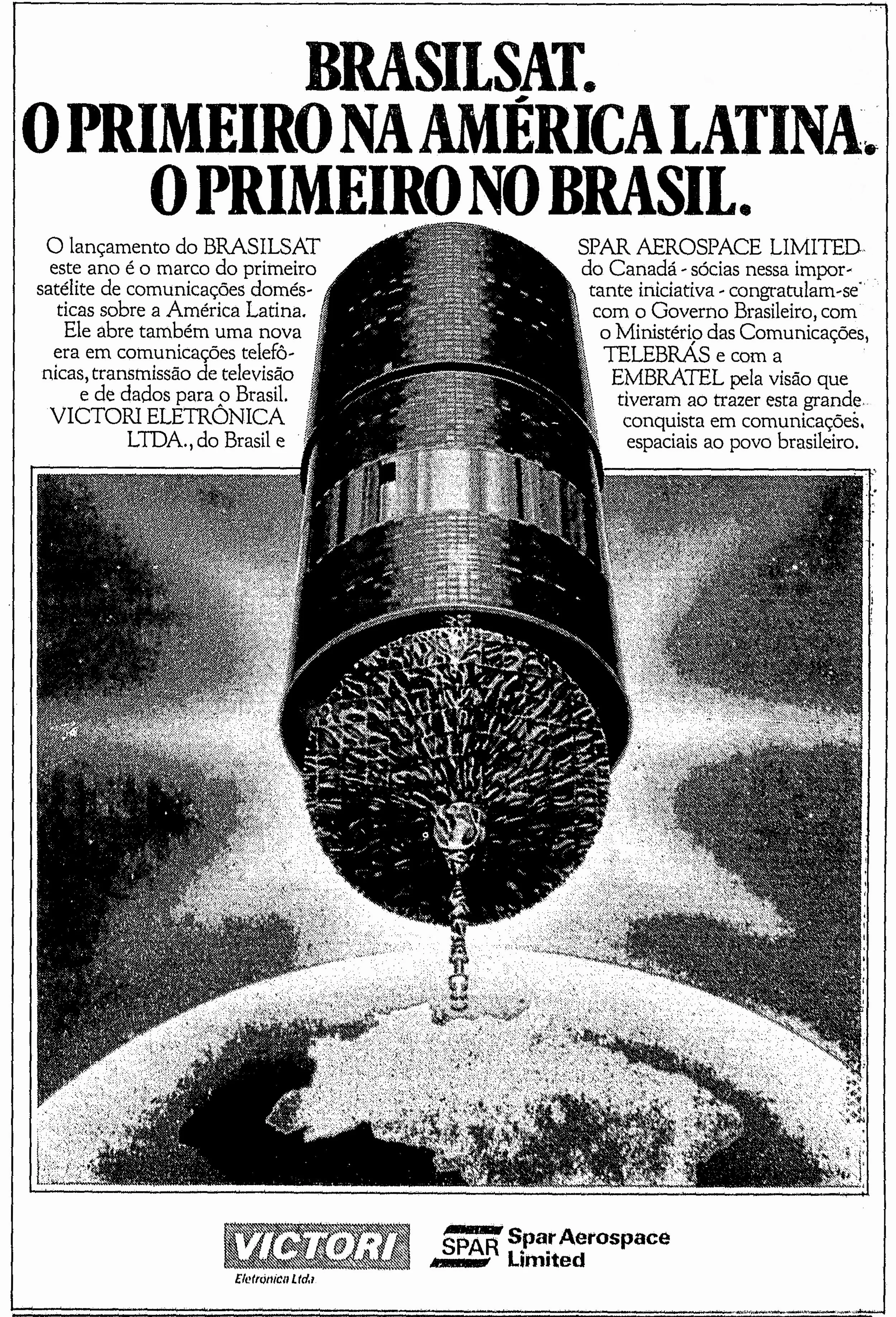
Brasilsat A1 is launched, O Globo, February 8th, 1985. “The first in Latin America. The first in Brazil.”
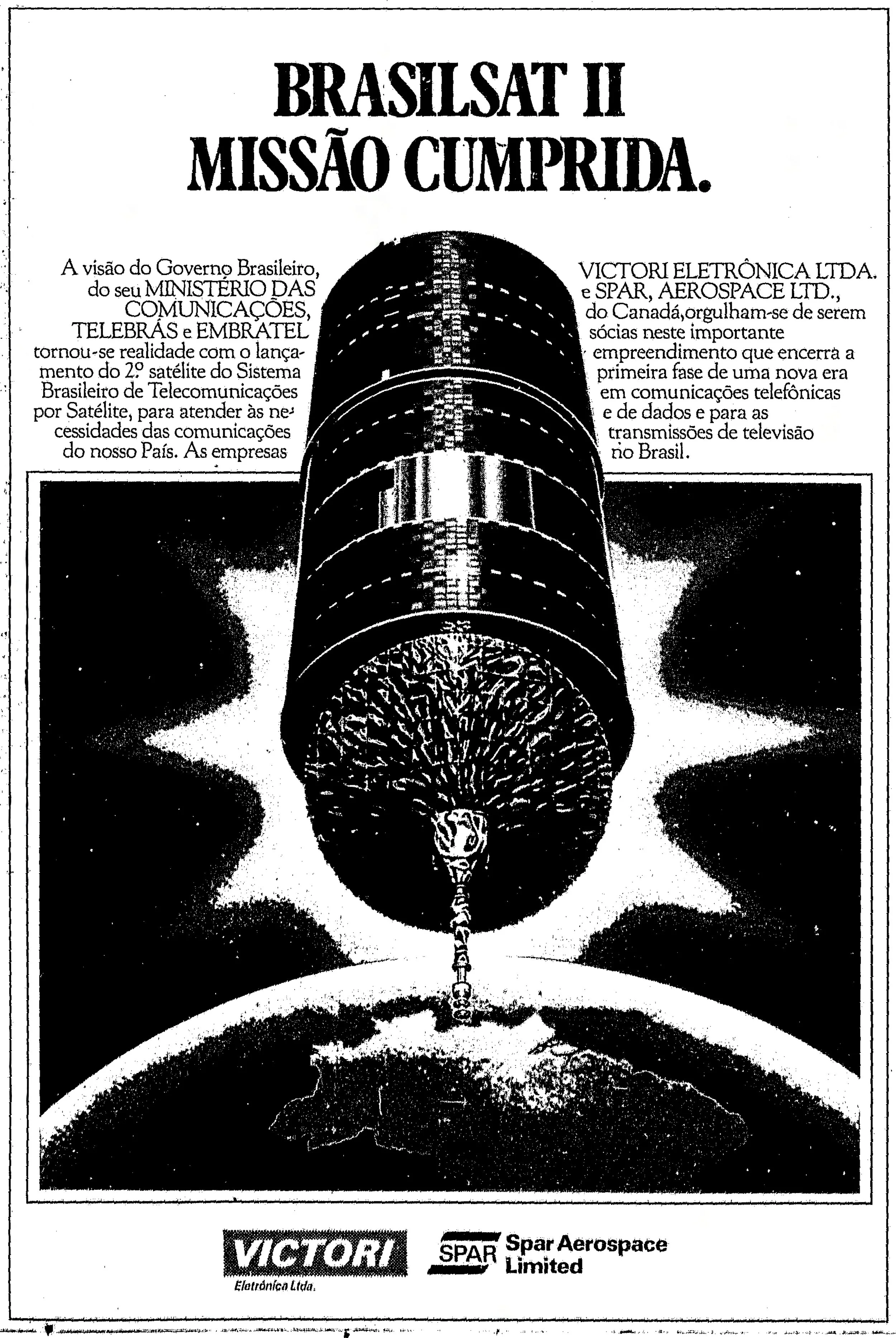
Brasilsat A2 is launched, O Globo, March 28th, 1986. “Mission Accomplished”
The SBTS program still stands as a unique example of Inter-American cooperation, one that brought closer together through space communications two of the largest nations in the western hemisphere: Canada and Brazil.
The contractual life span for both satellites was eight years, but Brasilsat I would go on to last 17, being moved into the graveyard orbit in 2002. Brasilsat II would last 18 years, being deactivated in 2004.
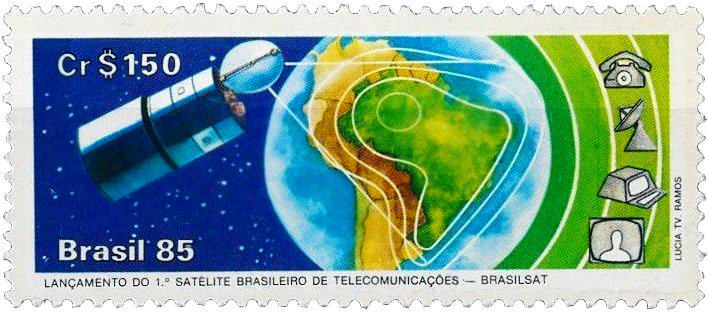
Commemorative stamp, 1985.
X.
The Brasilsat campaign was lead by Ireal’s experience and expertise, as well as his character. In Larry D. Clarke’s eulogy for Ireal, he said Ireal’s work in Brazil was:
“…a challenge which was to draw to the full on his technical and marketing experience, his business negotiating skills, his imagination, his tenacity, and above all, his absolute credibility. His credibility in this instance is particularly significant when you realize that it was appreciated in the fullest degree, by those in a foreign country, with a different language and very dissimilar social and business cultures… It was clear from the start that a remarkable empathy existed between Don and all whom we met in Brazil. This empathy broke down the barriers which frequently are so difficult to overcome between people of different languages and backgrounds. In the years that followed, I noticed this remarkable quality of Don’s to achieve the same results in his business dealings in many countries around the world across barriers of language, colour, and creed. In a real sense, Don was a man-of-the-world.”
- Larry D. Clarke, CEO, Spar Aerospace Limited
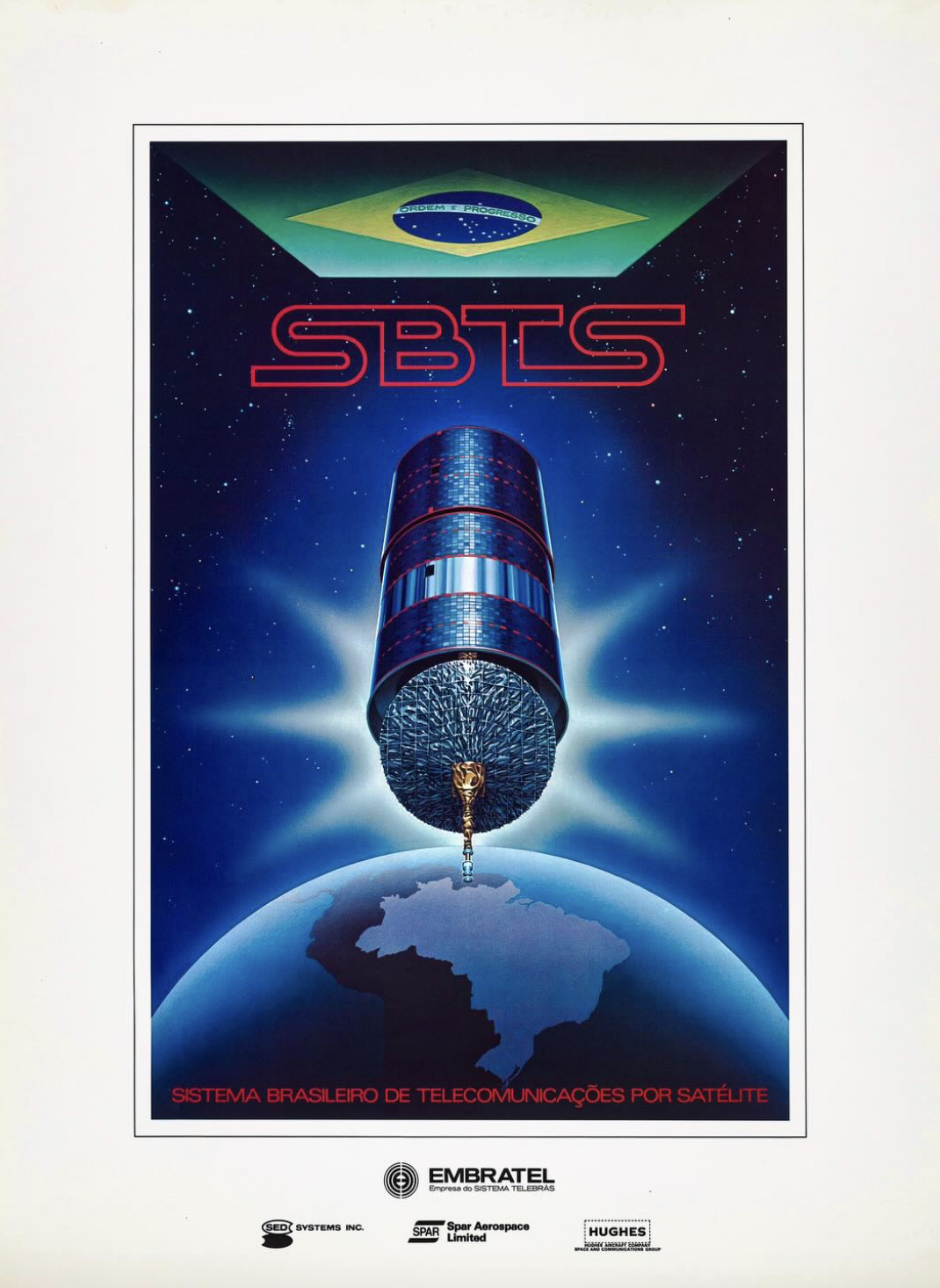
The official Hughes SBTS poster, 1985.
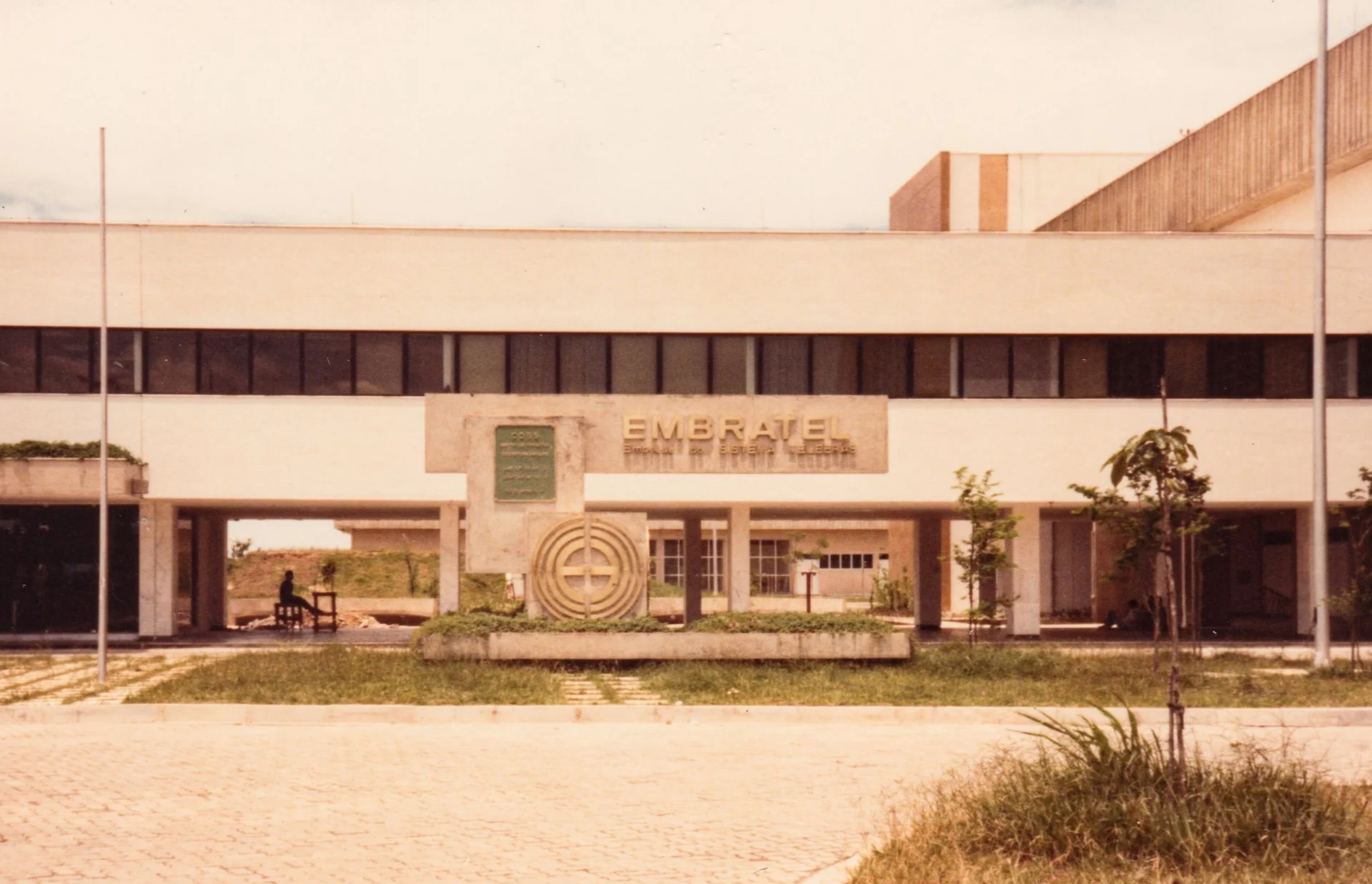
Ireal visited Embratel’s Brasilsat Control Centre in Guaratiba, 1985.
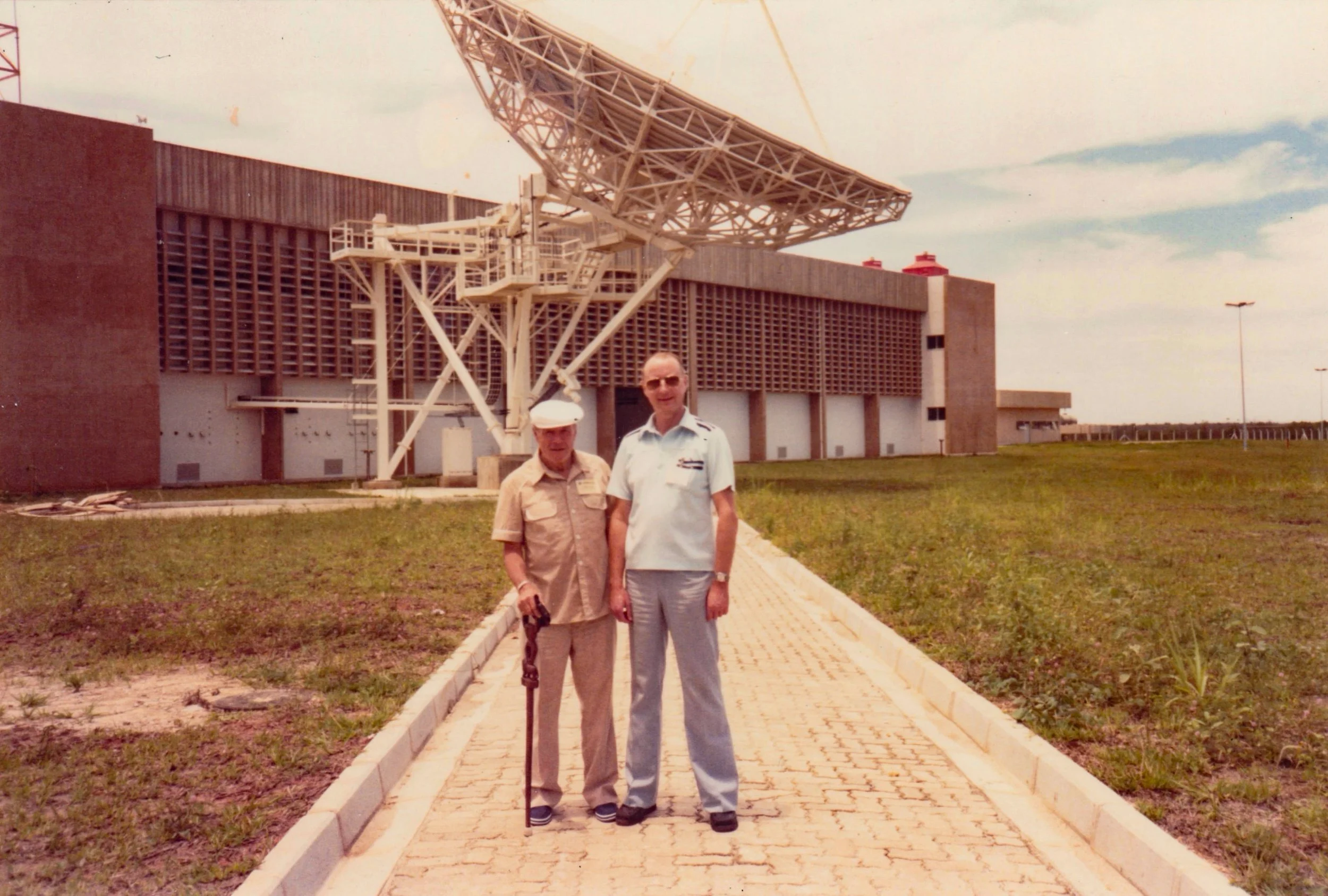
Ireal (left) and an Embratel employee outside the main building.
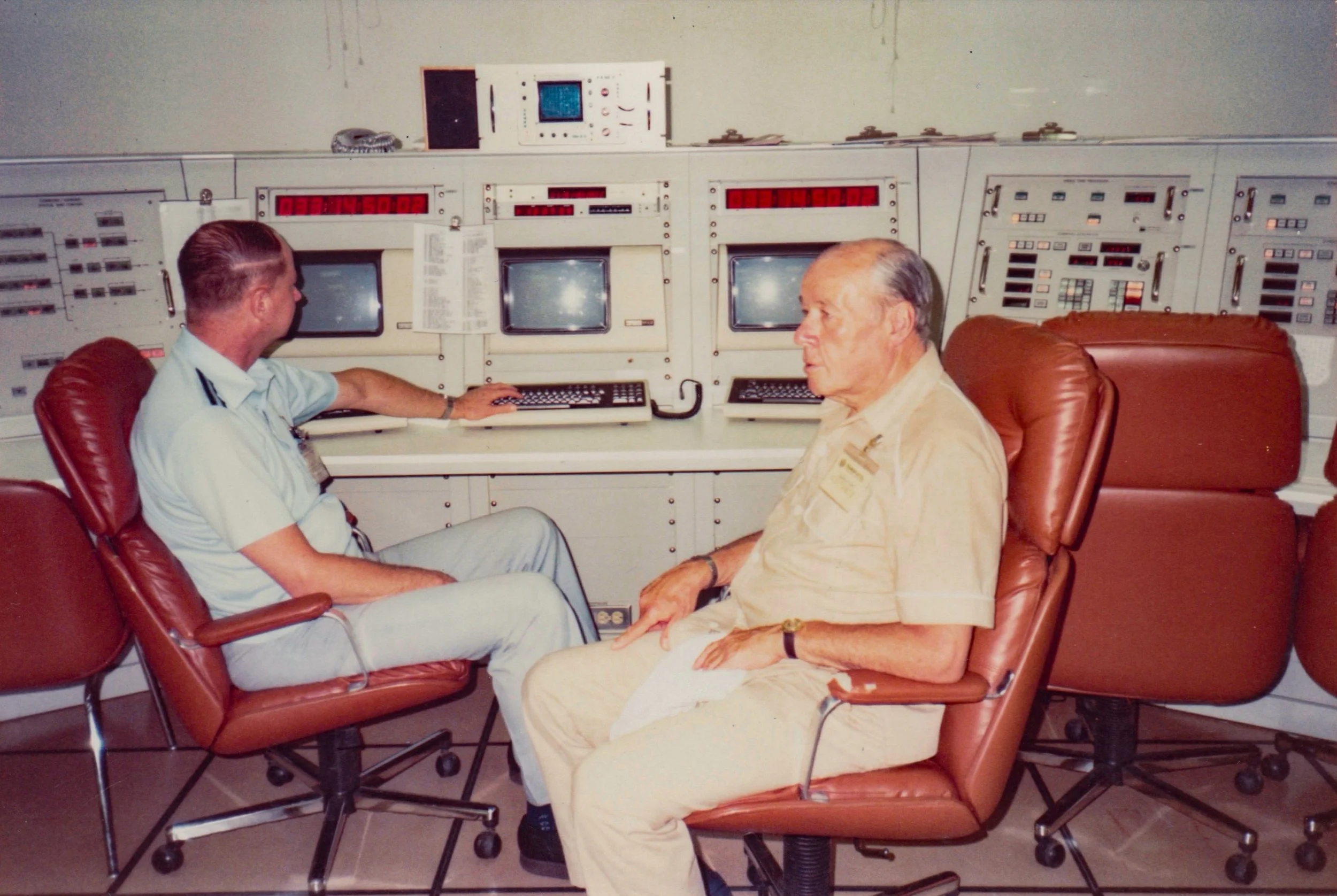
Ireal sitting in the control room, 1985.
Epilogue.
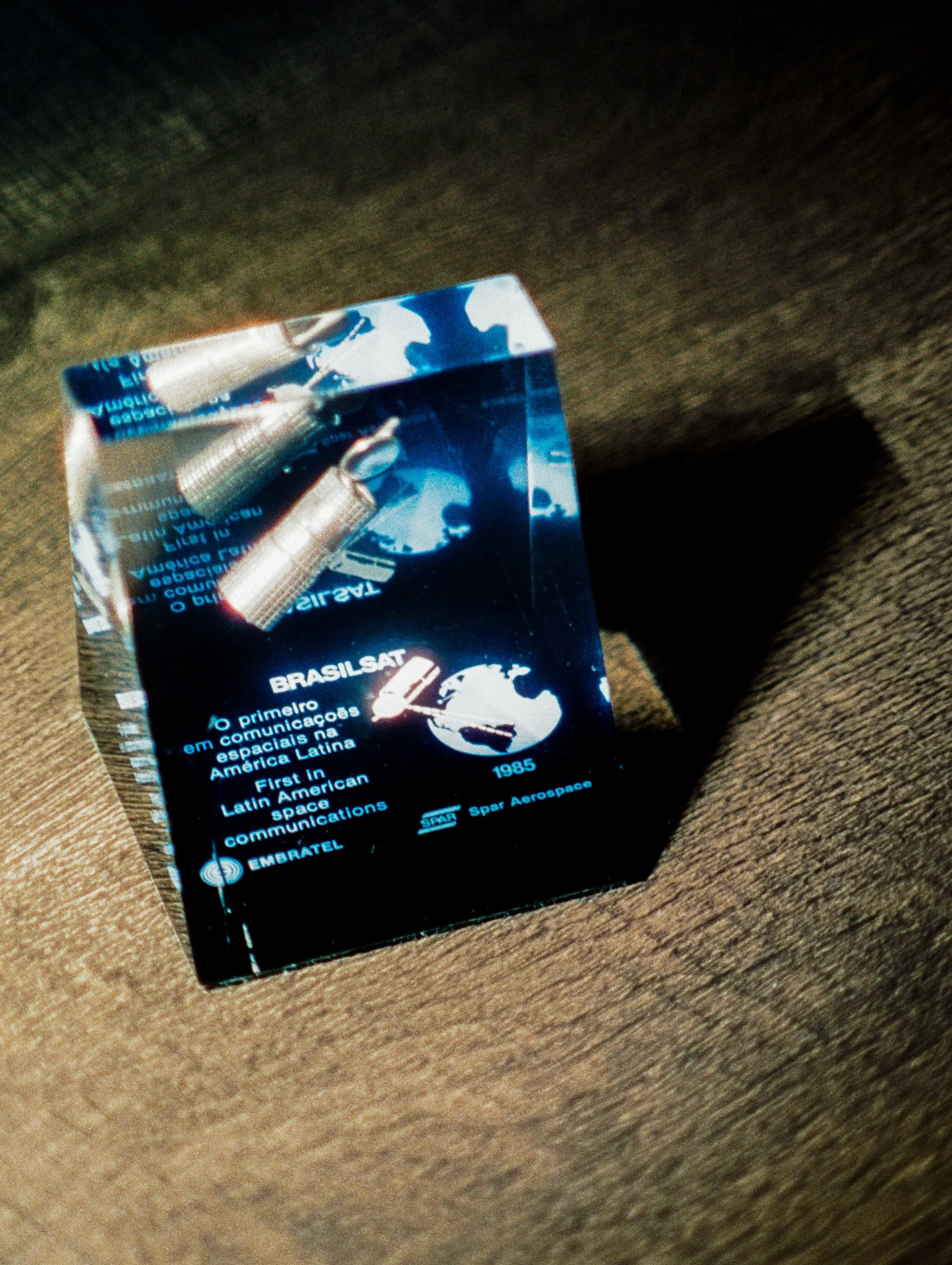
Commemorative resin paperweight, 1985.
Spar Aerospace Limited would never reaffirm their status as an international supplier of satellites, as Brasilsat remained their only international prime contract by the time the company sold its satellite systems division in 1998. Embratel would award the prime contract for the second and third generations of Brasilsat to Hughes in 1990, with B1 and B2 launching in 1994 and 1995 respectively, and B3 and B4 launching in 1998 and 2000. As of 2021, all of the second and third generations have been deactivated. Embratel became a private company in 1998 when it was sold during the privatization and break-up of its parent company Telebrás. Embratel has been owned by Claro Brasil since 2015, and ceased as a brand in 2025.
When the Brazilian Telecommunications Association, TeleBrasil, celebrated their 30th anniversary in 2004, they published a large volume of their history, and a broad history of telecommunications in Brazil. It included several lists of individuals and organizations who influenced Brazilian telecommunications over the years, including one list of over 800 names titled “Formadores de opinião”—Opinion leaders.
There was one name on this list, and in the entire book, from Spar Aerospace.
Don Mayson.